The Multi-Million Dollar Problem: Stockouts and Obsolete Stock
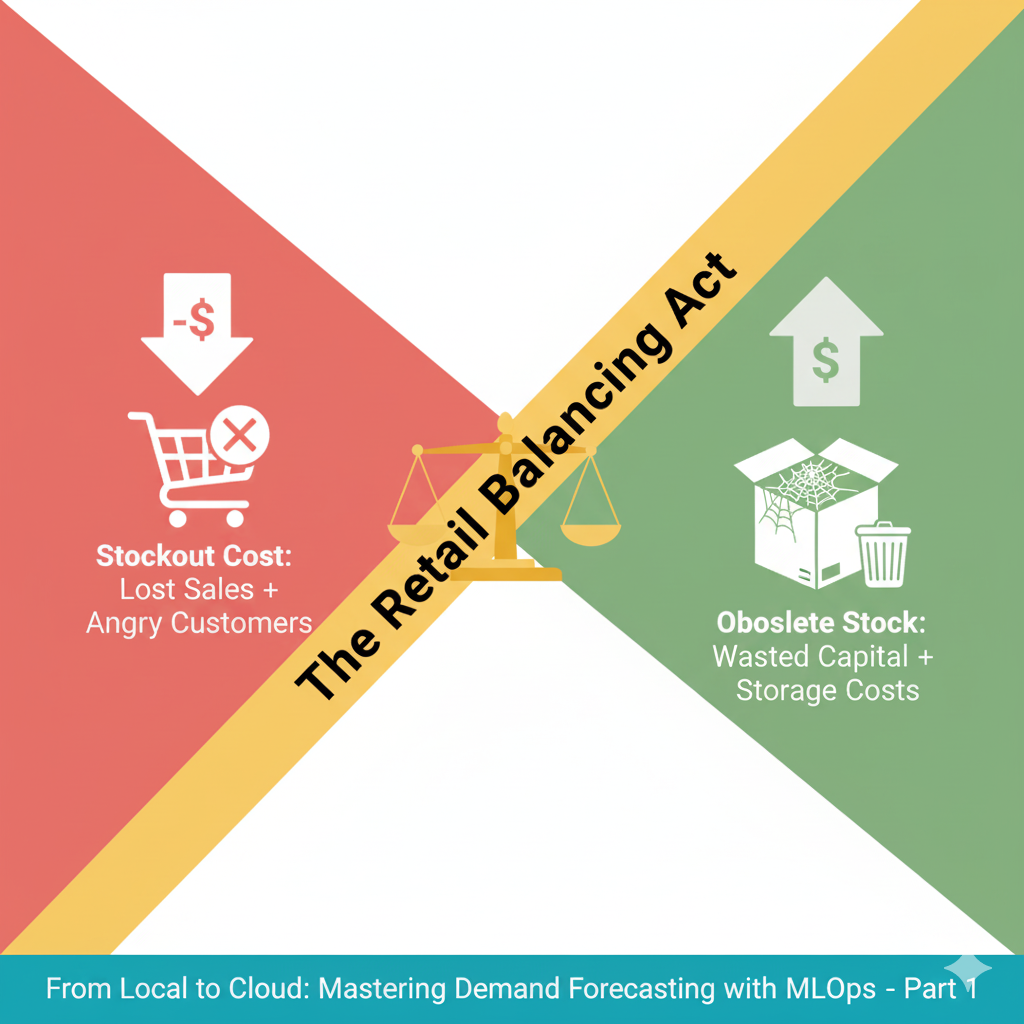
What if I told you that a 2% error in your forecasts could be costing your company millions? This isn’t a theoretical data science problem; it’s a daily reality in retail and supply chain management. The delicate dance between having too much and not enough inventory is where fortunes are won and lost.
As data scientists and ML engineers, we often get excited by model metrics like MAE and RMSE. But to truly deliver value, we must first understand the business problem we’re solving. In this series, we’ll tackle a critical challenge: How can we use MLOps to build a robust demand forecasting system that minimizes both stockouts and obsolete stock?
Let’s break down the two-headed monster every retailer fears.
The Visible Enemy: The Cost of a Stockout
When a customer arrives to find an empty shelf for a product they want, the immediate loss is the sale. But the repercussions run much deeper:
- Lost Customer Loyalty: A frustrated customer is likely to switch to a competitor, potentially for good.
- Brand Damage: Consistently poor availability erodes trust in your brand.
- Rush Orders & Expedited Shipping: To fix the gap, supply chain teams often place emergency orders, which come at a massive premium, destroying profit margins.
This is why we focus on metrics like the 98% Service Level. It’s not just a number; it’s a promise that for every 100 times a customer wants to buy a product, it will be available 98 times. That missing 2% is a direct leak from the bottom line.
The Silent Killer: The Burden of Obsolete Stock
While stockouts are a visible fire, obsolete stock is a slow-burning one that can be just as devastating. This is inventory that hasn’t sold and likely never will. It’s the other side of the imbalance.
- Capital Lock-up: Money that is tied up in dead stock isn’t available for marketing, new product development, or stocking best-sellers.
- Storage Costs: Warehouse space is expensive. Storing products that won’t sell is like paying rent on an empty apartment.
- Markdowns and Write-offs: Eventually, this stock must be sold at a significant discount or written off entirely, resulting in direct financial losses.
The Solution: Intelligent Demand Forecasting & Inventory Management
The common root cause of both these problems is a failure to accurately predict future demand. This is where our skills come into play. We aren’t just building models; we are building a central nervous system for the business.
But here’s the catch: a one-off Jupyter notebook that predicts sales for one product won’t cut it. We need a system that is:
- Reliable: It runs consistently, generating forecasts week after week.
- Scalable: It can handle thousands of products across hundreds of locations.
- Maintainable: It can be monitored, retrained, and improved as market conditions change.
This is the world of MLOps. It’s the engineering discipline that takes a model from a prototype to a production-ready asset.
Our Journey Ahead
In this series, we will walk through building this system, step-by-step:
- We’ll start locally on our laptops, establishing baselines with traditional time series models.
- We’ll then enhance our forecasts with Machine Learning, incorporating features like promotions and holidays.
- We’ll lay the MLOps foundation, structuring our project for reproducibility.
- We’ll hit the wall of local computation and see why we need the cloud.
- Finally, we’ll scale up on AWS, using services like S3, SageMaker, and Lambda to build a powerful, automated forecasting engine.
By the end, you will have a blueprint for solving this multi-million dollar problem. You’ll see how to bridge the gap between a local script and a cloud-native, business-critical application.
The first step is understanding the “why.” The next is building the “how.”